Iterations Exhibition and acknowledgments
We thank those who accompany us in the production of the exhibition “Iterations” by Cornelia Vargas at the MAM de Chiloe @mamchiloe. In particular we want to thank José Nordenflycht @josedenordenflycht, Coca Gonzalez @cocastral and Eduardo Feuerhake @e_feuerhake and the MAM Chiloé team, also Claudia and Mario Castillo @delcastillo.mario and the Universidad de Los Lagos, Sofia Vargas @sofia.valpo, Marion Koch and Bruno Vargas @bruno161_, Juvenal Barría @juvebarriag, Alejandro Galvez @alejogalvez and all those who accompany us and collaborate in the visibility of the work of Cornelia Vargas.
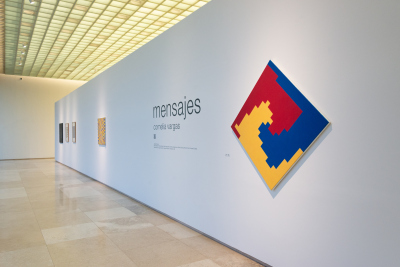
We invite you to visit the exhibition until December 19, 2024 at the Museo de Arte Moderno Chiloé located at Parque Municipal s/n in the commune of Castro. Cornelia Vargas exhibits 18 works in the context of the Muestra Regional de Arte Contemporáneo 2024, which will take place between October 19 and December 19. On December 7 and in the context of the holding of SAL XVIII in Chiloé, a guided tour by the artist of her exhibition will take place.
Iterations Exhibition 2024
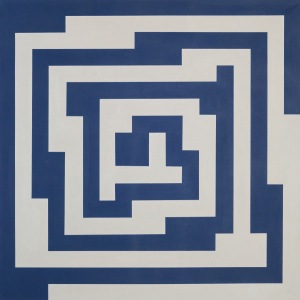
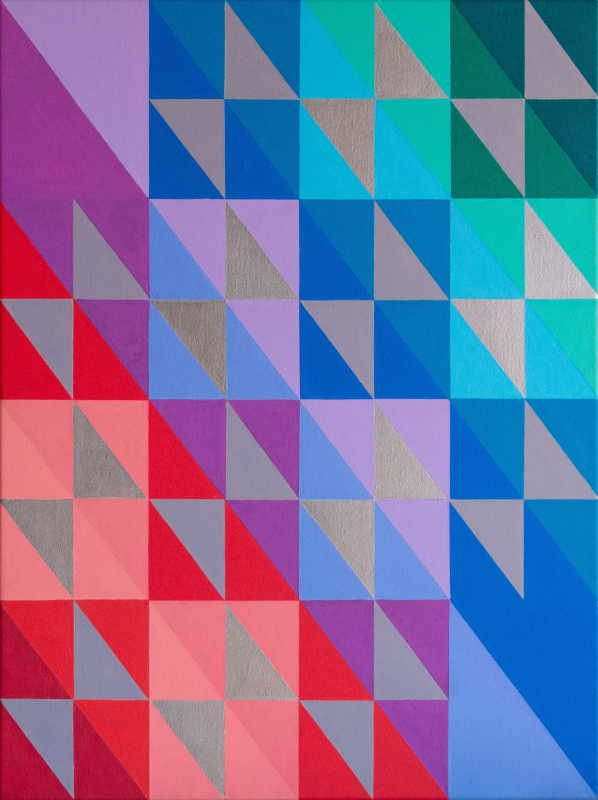
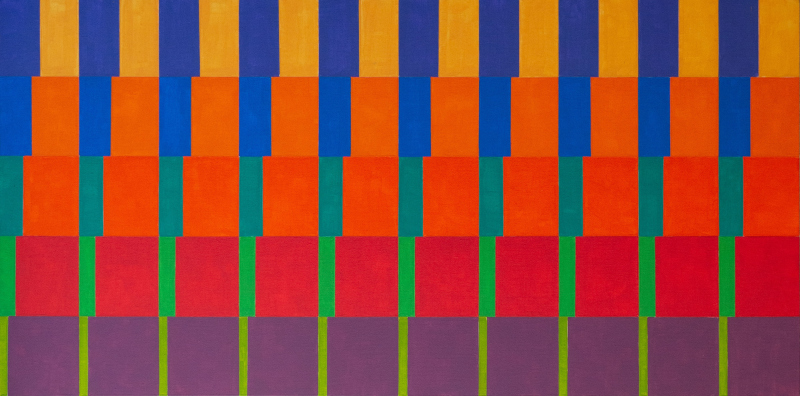
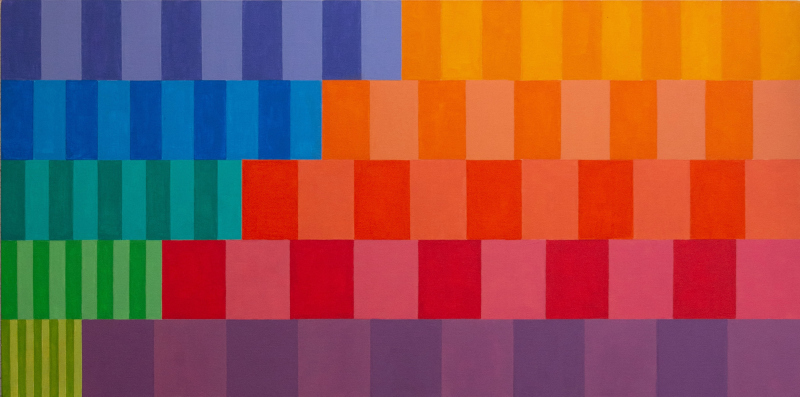
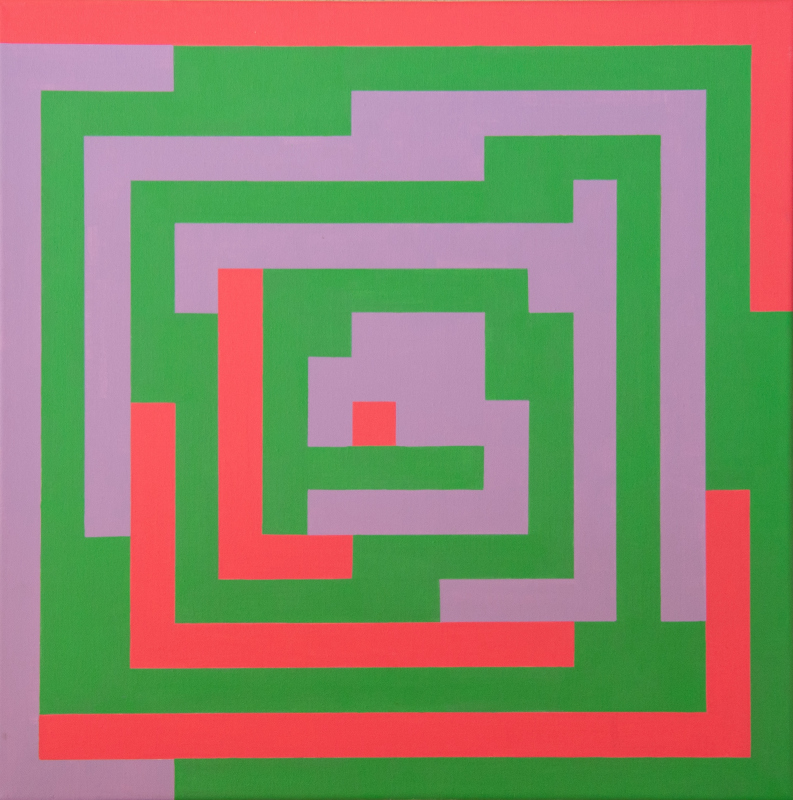
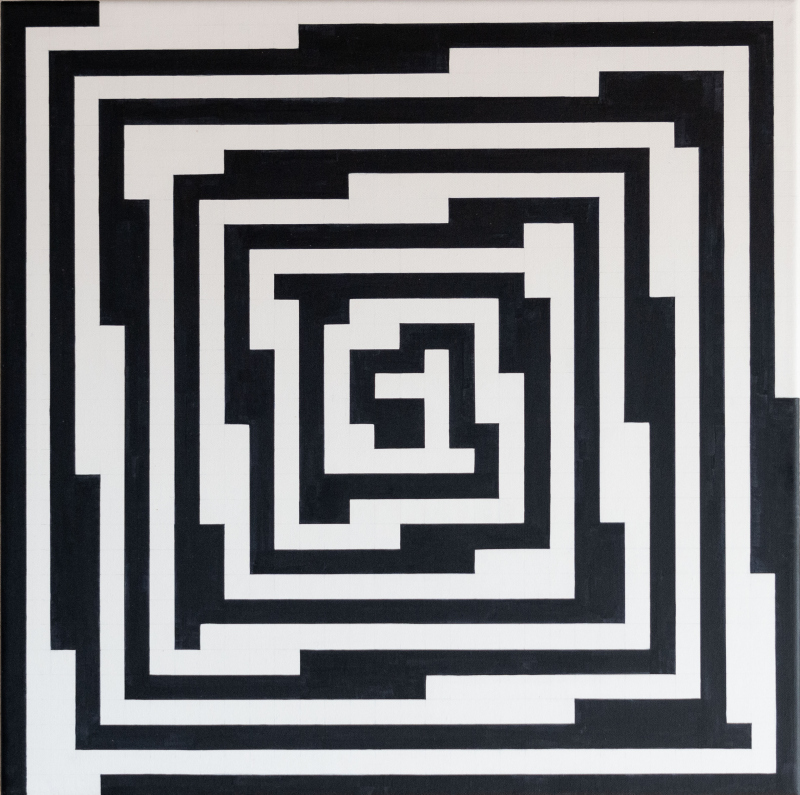
What I want to exhibit relates to the continuity of the process of increasing complexity in the configurations of my works. Following new series, the patterns I employ become surfaces whose structures disappear completely, in the polygons, the tessellations and the iterations.
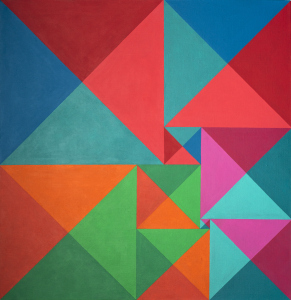
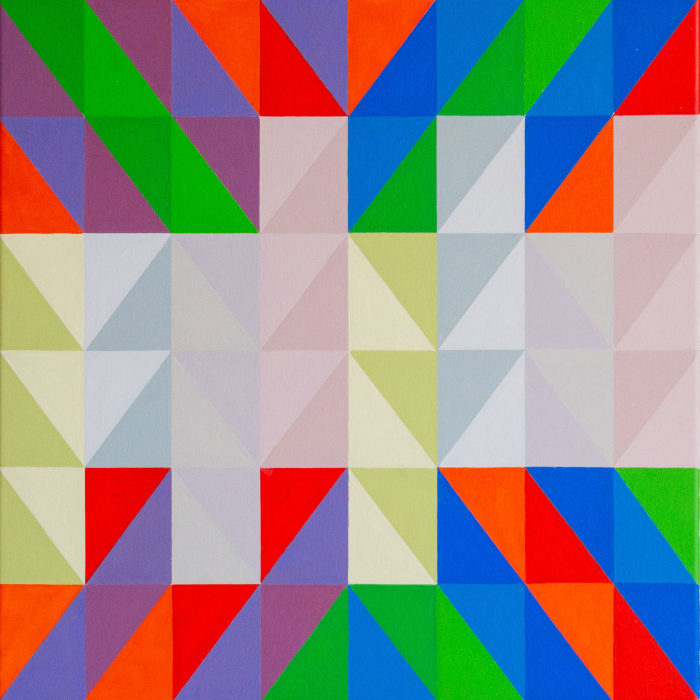
I have worked with the concept of 'tessellation', a term that comes from mathematics and refers to the covering of the Euclidean plane without gaps or overlaps through partial and uniform surfaces. This series is the continuation of the work previously carried out in the Polygons series, which now continues with the Iteration series where the surface is subdivided into triangles creating orientation and rhythm over the structure.
As an example, I describe the process of the creation of the current series presented here under the title iteration. The format of the painting 60 x 80 cm with its diagonal of 100 cm gives the proportion of a Pythagorean triple 3-4-5, a right triangle with legs 3, 4 and the hypotenuse is 5. Successively, the number of elements is multiplied by 4 and their size is reduced at the same time generating fractals. It leaves space for the interpretation of variations.
"Concrete painting and sculpture are the creation of the visually perceptible. Their means of expression are colors, space, light and movement. Through the formation of these elements new realities emerge. Abstract ideas, which previously only existed in the imagination, become visible in concrete form. Art is information, because it transports an aesthetic content: an exchange between the past and the future. It is not understandable without a deeper reflection, but it is indispensable." [1]
"Since a great number of variations exist within these narrow and clearly defined limits, the fact that a single theme – that is, a single fundamental idea – leads to fifteen very different developments can be considered proof that concrete art contains an infinite number of possibilities. ... With this method, once the basic theme has been chosen – whether simple or complex – an infinite number of very different developments can arise according to individual inclination and temperament."[2]
"Invisible, abstract thought becomes concrete, graphically describable and, therefore, also sensorially perceptible. Unknown spaces take shape, almost unimaginable axioms: spaces are conceived that previously could not be imagined and, by becoming accustomed to them, sensitivity is expanded for other spaces that perhaps are still unknown today. The mathematical conception of the art of our time is not mathematics in itself; it may even barely make use of what is usually understood as exact mathematics, rather it is a matter of applying logical thoughts to the figuration of rhythms and relationships, of laws of individual origin,[3]
I do not attempt to abstract myself from reality, but rather I seek to create a new one. Therefore, my works should not be understood as illustrations of mathematical problems, although logic influences my work. Although the strict and definitive mode of mathematics opens the way to make the work of art, it finally occurs when I tell myself that I am going to work with contrasts. And that is no longer based on mathematics. The method then becomes a way of working knowing that, in the end, there is always an additional theme to the structure.
Cornelia Vargas
[1] Max Bill, No Beginning No End, Marta Herford, Scheidegger & Spiess, Translation CV
[2] Max Bill, Die grafischen Reihen, Exhibition and book Landratsamt Esslingen, 1995, Max Bill, Zurich, November 1938, Translation CV
[3] Max Bill, 2G, Mathematical thought in the art of our time
Iterations by Cornelia Vargas for the XVI Muestra Regional de Arte Contemporáneo of @mamchiloe
#centroactivodeartecontemporáneo #islagrandedechiloé #mamchiloé #corneliavargas #konkretekunst #arteconcreto #arteconcretoinvencion #artconcret #artconcrete #conceptart #konzeptkunst #abstractart #geometricabstraction #geometricartwork #geometrischekunst #geometricalart #artegeometrica #artegeometrique #femaleartist #womeninart #womeninarts #chile #mujeresenelarte #mujeresartistas #iteraciones #mamchiloe #Chiloe

Post date
23 Oct, 2024
Related content